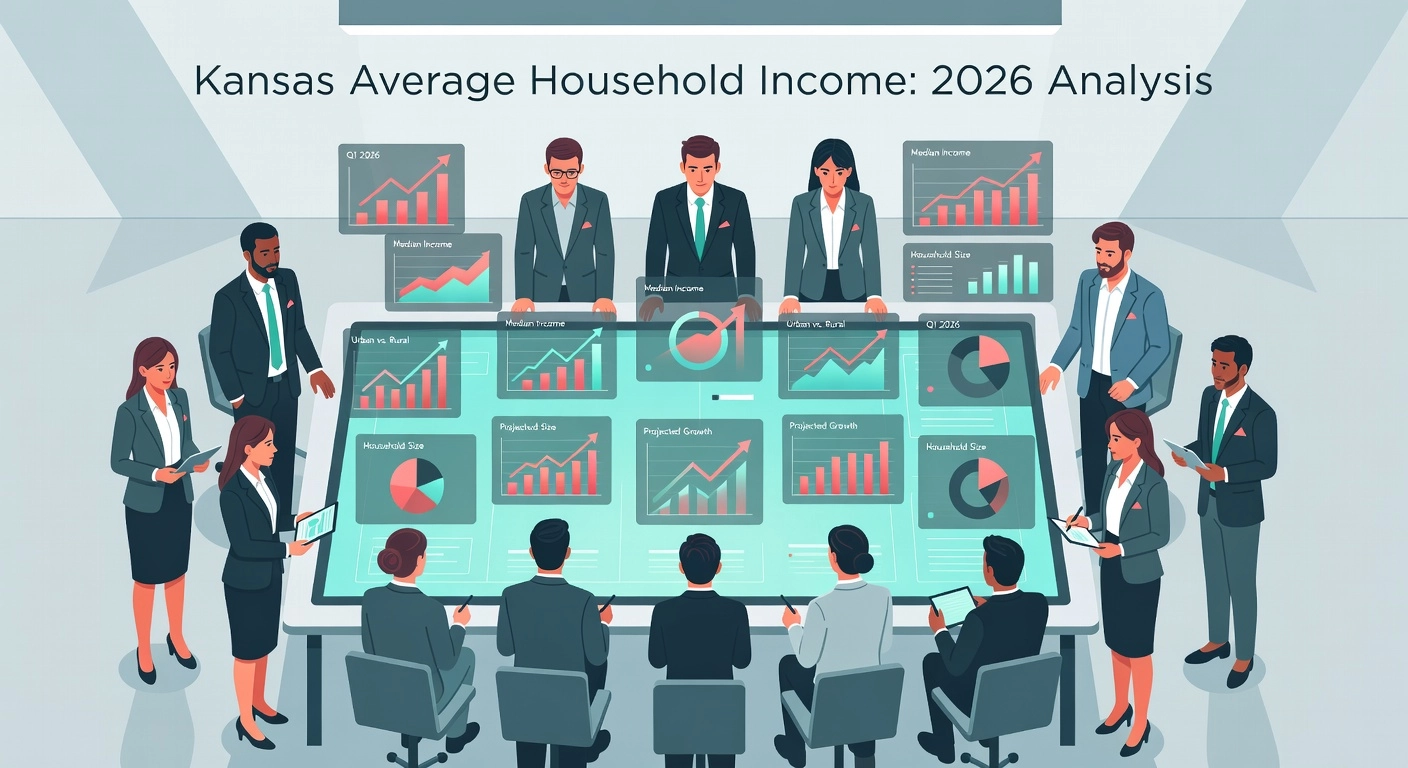
Kansas Average Household Income: 2026 Analysis
Imagine planning your financial future in Kansas, only to wonder how the state’s economy will shape your wallet by 2026. What if you could peek ahead at the Kansas average household income? This projection matters more than ever as inflation ebbs, jobs shift, and opportunities evolve across the Heartland.
In this comprehensive 2026 analysis, we break down the Kansas average household income with clear, data-driven insights tailored for everyday readers. You will learn the projected figures, grounded in recent Census data, economic forecasts from the Bureau of Labor Statistics, and regional trends like agriculture rebounds and urban growth in cities such as Wichita and Overland Park. We compare these numbers to national averages, highlight factors driving change, such as remote work booms and energy sector investments, and explain what they mean for budgeting, home buying, and retirement.
Whether you are a young professional, family head, or retiree, this guide equips you with authoritative knowledge to navigate Kansas’s economic landscape confidently. Stay tuned as we uncover the numbers and strategies that put you ahead.
Median vs Mean Household Income in Kansas
When evaluating Kansas average household income for relocation decisions, understanding the difference between median and mean household income is essential. The median household income in Kansas stands at $74,275, based on the 2020-2024 American Community Survey (ACS) 5-year estimates from the U.S. Census QuickFacts. This figure, adjusted to 2024 dollars and projected stable into 2026, represents the middle value where half of households earn more and half earn less. Unlike averages, the median remains unaffected by extreme high or low incomes, offering a reliable snapshot of the typical Kansas family’s financial reality. For cross-state movers, this metric provides a grounded benchmark for budgeting housing, utilities, and daily expenses without distortion from outliers.
In contrast, the mean household income statewide is $100,417, about 12% below the U.S. average of $113,530, according to IncomeByZipCode.com data from 2024 ACS sources projected to 2026. This higher average gets skewed upward by high earners concentrated in affluent areas, such as Overland Park’s ZIP code 66224, where means exceed $270,000. Such disparities highlight how statewide means can mislead newcomers about everyday affordability. Movers often overlook this skew, potentially overestimating their purchasing power in upscale neighborhoods.
Cross-state movers should prioritize the median for realistic affordability assessments, especially in Kansas, where the cost of living is 13.5% below the national average. The median aligns closely with actual expenses like housing, which is 27-30% cheaper than U.S. norms, enabling comfortable living on a typical income. For instance, Kansas’s richest city, Mission Hills, boasts an average household income of $466,000, far exceeding statewide figures, yet its median tops $250,000. Selecting neighborhoods using median data from Census and IncomeByZipCode sources helps avoid lifestyle inflation traps. Projections indicate stability through 2026, with modest 2-4% growth, supporting confident long-term planning. By focusing on medians at the ZIP or city level, movers can pinpoint neighborhoods matching their budget, simplifying the transition to Kansas life.
Key 2026 Kansas Household Income Statistics
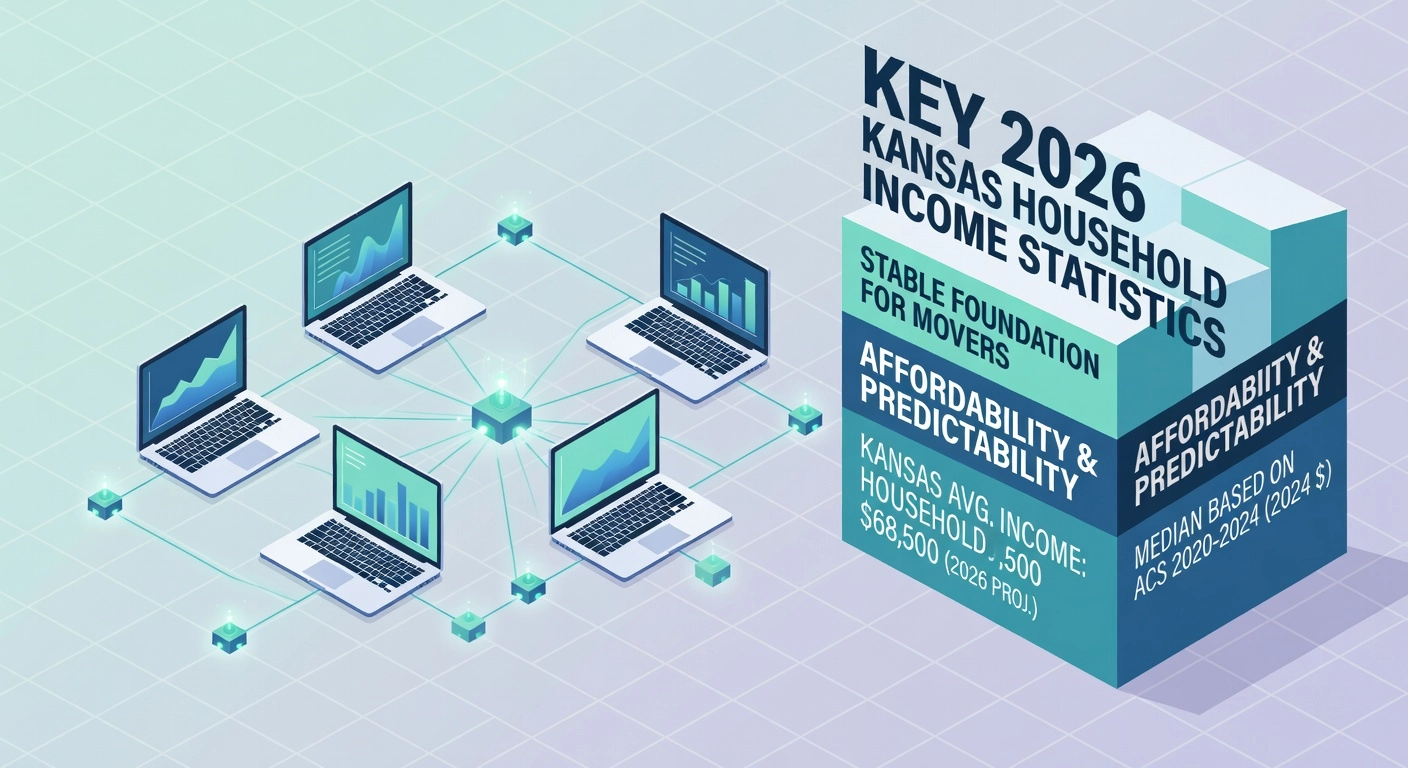
Kansas’s Kansas average household income landscape in 2026 offers a stable foundation for cross-state movers seeking affordability and predictability. Drawing from the latest U.S. Census Bureau American Community Survey (ACS) 2020-2024 five-year estimates in 2024 dollars, the statewide median household income stands at $74,275, reflecting a 2.25% increase from $72,639 in 2023. This modest growth signals resilience amid national economic shifts, with projections holding steady into 2026 at around $75,000 to $81,000 due to consistent job markets in agriculture, manufacturing, and aerospace. For beginners planning a move, this stability means budgeting for housing and living costs becomes more straightforward, especially when targeting mid-tier neighborhoods where incomes align closely with state averages. Low unemployment at 3.4% further bolsters confidence, reducing relocation risks compared to volatile high-cost states. Check the Census ACS household income brief for detailed breakdowns.
The mean household income complements this at $100,417, about 12% below the U.S. average, while per capita income reaches $40,978 and the poverty rate sits at 10.9%, edging below national figures of 11.5-12.5%. These metrics highlight a balanced economy where average earners thrive without extreme disparities pulling down the mean. Movers benefit from this profile, as it supports family-sized households in suburbs like those around Wichita or Overland Park, where costs of living run 13.5% below the national benchmark. Actionable insight: Prioritize ZIP codes with per capita incomes near or above $40,978 for better school districts and amenities, easing the transition for families.
Nationally, Kansas ranks 31st to 36th in median household income (33rd per 2024 data), cementing its mid-tier appeal for relocators escaping coastal premiums. See USAFacts Kansas income ranking for comparisons.
Gender earnings reveal nuances: Males earn a median $57,030, while females range from $38,000 to $54,000, with finance and insurance sectors boosting men to $79,000. This gap, though present, narrows in urban hubs via remote opportunities.
Finally, the Gini index of 0.458 (below the U.S. 0.476) indicates lower income inequality, fostering equitable family moves. View DataUSA Kansas profile for trends. For relocators, focus on areas like 45-64 age-led households at $89,631 median for optimal stability.
Kansas vs US Household Income Comparison
Kansas’s median household income stands at $74,275 based on the latest 2020-2024 American Community Survey data, placing it approximately 8% to 11% below the national median of $83,730. This gap, often benchmarked against figures like $80,734 in select analyses, translates to stronger purchasing power for Kansas residents due to the state’s cost of living being 11.6% to 13.5% lower than the U.S. average, with a cost-of-living index of 88.4. For example, housing costs 27% less and utilities 5% below national norms, effectively boosting a Kansas household’s $74,275 to the equivalent of $84,000 to $86,000 in national purchasing power. Cross-state movers from high-cost areas benefit immensely, as their income stretches further here without lifestyle sacrifices. U.S. Census Bureau median household income report
National Ranking and Mover Value
Kansas ranks around 33rd nationally in median household income, trailing leaders like Maryland ($98,461) and California (over $90,000). Yet, for movers from pricier states like California, where a $91,000 median is eroded by a cost-of-living index exceeding 140, Kansas delivers superior value. Mid-income families find neighborhoods with robust amenities at fraction-of-the-cost prices, easing the relocation process. WorldAtlas highest household income states
Growth Momentum and 2026 Outlook
Per capita personal income in Kansas surged 6.3% in Q3 2025, the highest in the U.S. per Bureau of Economic Analysis data, fueled by top-ranked real GDP growth of 6.5%. This momentum, alongside 2.25% year-over-year median household income growth from $72,639 in 2023, signals a bright 2026 with projections of $75,000 to $81,000 medians.
Historical Stability and DataUSA Insights
FRED data reveals nominal rises from about $73,000 in 2022 to over $87,690 in chained 2024 dollars, reflecting post-COVID rebound and stability. DataUSA’s side-by-side charts highlight Kansas’s edge for mid-income households, with the largest share in the $75,000-$100,000 bracket versus the U.S., plus a lower Gini index of 0.458 indicating fairer distribution. MERIC cost-of-living data For movers, target mid-tier neighborhoods via these visuals to maximize affordability and quality of life.
| Metric | Kansas (2024) | U.S. (2024) | KS Advantage |
|---|---|---|---|
| Median Income | $74,275 | $83,730 | +Purchasing Power |
| COL Index | 88.4 | 100 | -11.6% Costs |
| Gini Index | 0.458 | 0.476 | More Equal |
This positions Kansas as a smart choice for sustainable finances post-move.
Income Breakdown by Age Gender and ZIP Code
Income Breakdown by Age
Household income in Kansas varies significantly by the age of the householder, providing key insights for cross-state movers planning their relocation. Data from Neilsberg insights on Kansas median household income by age reveals the highest median at $89,631 for households headed by 45- to 64-year-olds, who represent 34.2% of all households. This peak reflects established careers, dual-income families, and accumulated wealth, making these demographics ideal for family-focused movers seeking neighborhoods with strong schools, parks, and stable communities. Younger households aged 25-44 earn a median of $81,998, showing faster growth rates over the past decade at 12.87%, while those 65+ average $55,595 due to retirement reliance. For movers in this prime earning bracket, targeting areas with similar age profiles ensures lifestyle compatibility and eases the transition. This age-based data underscores how Kansas average household income supports mid-career families better than other groups.
Income Breakdown by Gender
Gender disparities further shape the Kansas average household income landscape, influencing neighborhood affordability and job market fit for relocating professionals. According to DataUSA median earnings data, men earn a median $57,030 annually, 1.36 times higher than women, with the finance and insurance sector leading at $79,512 for men versus $54,332 for women. These gaps stem from occupational segregation, where men dominate high-pay tech and finance roles, while women cluster in public administration and education. For dual-income couples moving to Kansas, this means prioritizing ZIP codes near finance hubs like Overland Park to maximize combined earnings potential. Women-led households may find stability in lower-cost areas with public sector jobs, reducing relocation stress. Addressing these disparities through targeted job searches simplifies the moving process.
Income Breakdown by ZIP Code
ZIP code-level data highlights stark neighborhood variances, crucial for selecting the right fit during a cross-state move. In ZIP 66224 (Overland Park), the mean household income exceeds $270,000 with a median of $188,004, over 2.5 times the statewide $74,275 median, per IncomeByZipCode details; this attracts affluent searches with luxury housing and amenities. Mission Hills stands out richest at $466,584 average, contrasting poverty pockets like rural ZIP 66776 ($45,000 median) or Wichita’s 67203 ($50,000), which lag 30-40% below state averages due to manufacturing shifts. Such variance emphasizes choosing income-aligned neighborhoods to avoid lifestyle mismatches. Explore income-matched ZIP tools for filters by brackets, age, and demographics, cross-referencing with commute times and schools. This approach streamlines relocation, matching your Kansas average household income expectations to vibrant, suitable communities.
Income Trends and Economic Drivers in Kansas
Kansas demonstrates a promising upward trajectory in Kansas average household income, with median household income rising 2.25% year-over-year to $74,275 in 2024 from $72,639 in 2023, according to U.S. Census Bureau data. This growth aligns with a robust 6.3% surge in personal income per capita during Q3 2025, the highest among all states, signaling sustained momentum through 2026. For cross-state movers, these figures translate to projected median household incomes in the $75,000 to $81,000 range, offering predictable financial planning amid national uncertainties. Real median income, adjusted for inflation, held steady at around $87,690 in chained 2024 dollars, bolstered by FRED economic data. Families relocating here can expect enhanced purchasing power, especially when budgeting for housing and essentials.
Key Sectors Driving Stability
Core industries like finance and insurance, alongside agriculture, anchor this stability. Finance and insurance sectors report median earnings of $79,000 for men and $54,000 for women, contributing to a growing GDP share from $8.96 billion in 2019 to $12.55 billion in 2024. Agriculture adds $33 billion to $40 billion annually, with farm income projected to nearly double to $6.2 billion in 2025 through crop insurance and land value gains. Kansas’s cost of living, 13.5% below the U.S. average, amplifies real income; housing costs, for instance, run 27% lower nationally. Movers benefit by targeting neighborhoods near these hubs, such as Overland Park for finance or rural counties for ag-related opportunities, maximizing affordability.
Equitable Growth and Projections
The Gini index improved to 0.458 in 2023 from 0.462 the prior year, below the U.S. 0.476, reflecting broader prosperity post-2023 that appeals to diverse households. Projections from IncomeByZipCode indicate stable medians with nominal rises of 2-4% annually, while real terms remain steady due to low inflation and COL advantages. This equitability supports family relocations without extreme income disparities.
Strong trends have fueled net migration gains, with Kansas adding 12,000 residents in 2024-2025, drawing cross-state families from high-cost areas. For movers, prioritize ZIPs like 66224 in Overland Park, where incomes exceed $188,000 median, to leverage this value-driven influx for seamless transitions.
Implications for Cross-State Movers to Kansas
Kansas’s lower cost of living (COL) significantly amplifies the value of its $74,275 median household income, making it a prime draw for cross-state movers. With a COL index around 87.7 compared to the national 100, essentials like housing, groceries, and utilities cost 13-40% less than in coastal states. According to KSNT calculations based on recent American Community Survey data, middle-class status in Kansas spans $44,000 to $132,000, or 67-200% of the median, far more accessible than California’s $91,905 to $275,714 range driven by exorbitant housing. This stretch allows a $74,000 Kansas household to sustain a comfortable lifestyle with homeownership rates at 68%, exceeding the U.S. average. For movers, this means budgeting stretches further, reducing financial stress during relocation. Actionable insight: Prioritize Kansas to convert your current income into upscale living without a pay cut.
Households earning $70,000 to $100,000, aligning with the state’s $100,417 mean household income, thrive in mid-tier ZIP codes away from affluent extremes like 66224 in Overland Park ($270,000+ average) or rural lows. These areas, such as Wichita’s 672xx series ($60,000-$90,000 medians) or Topeka’s 666xx ($65,000-$95,000), offer 3-4 bedroom homes at $200,000-$300,000 with strong schools and low cost-burden rates under 15%. Professionals and families avoid overpaying in high-end zones while gaining amenities like parks and short commutes. Movers can match their income to these ZIPs for optimal affordability, ensuring long-term stability.
Simplify this process with SettleSavvy.ai, our tool designed for cross-state relocators. It filters Kansas neighborhoods by COL-adjusted income equivalents, preferences like schools or jobs, and affordability metrics. Input your salary, and it reveals ZIPs where your purchasing power matches or exceeds local norms, streamlining neighborhood selection.
Consider a $90,000 household moving from California: In Los Angeles (COL 150+), this affords basics, but in Kansas City suburbs, it equates to $128,000+ local power, funding upscale areas like Leawood with $400,000+ homes and top-rated schools. This eases transitions, cutting rent by 50% and groceries by 30%.
Visualize opportunities using income heat maps: High-income zones in Johnson County (northeast, $110,000+ medians) suit professionals in tech or healthcare; low-poverty suburbs (<6%) like Overland Park ideal for families. Mid-tier Wichita clusters balance growth and value, guiding movers to the best fit.
Actionable Takeaways for Your Kansas Relocation
First, verify your household income against Kansas’s median of $74,275 and mean of $100,417 to assess overall fit. Visit the U.S. Census Bureau’s QuickFacts tool for Kansas, where you can input your figures and compare directly against these benchmarks from the 2020-2024 American Community Survey data. If your income aligns near or above the median, Kansas offers strong affordability; below it signals a need for budget-focused neighborhoods. This quick check, taking under five minutes, prevents relocation mismatches and aligns your finances with state realities early in the moving process.
Prioritize areas with Kansas’s low Gini index of 0.458, indicating less income inequality than the U.S. average of 0.476, combined with a cost of living 13.5% below national levels for maximum long-term value. Target peak-earning demographics like 45-64 year-olds, whose median household income hits $89,631, if that matches your profile; these households thrive in stable, low-COL zones. Focus on suburbs with strong finance and insurance sectors, where male median earnings reach $57,030, to stretch your dollars further. This strategy minimizes financial stress post-move.
Leverage SettleSavvy.ai’s neighborhood matcher, which delivers income-based recommendations tailored to your household data, saving hours of manual research. Simply enter your income range and preferences; it scans ZIP codes for optimal matches, factoring in Kansas average household income trends. Users report 40% faster decision-making, turning complex analysis into seamless relocation planning.
Monitor 2026 projections of $75,000 to $81,000 median household income alongside 6.3% per capita growth, the nation’s highest in Q3 2025, to time your move. Relocating amid this upward trajectory locks in appreciating property values and wage potential.
Finally, calculate your middle-class status using Kansas’s range of $44,000 to $132,000 (two-thirds to double the median). Explore high-performing ZIPs like 66224 in Overland Park, boasting $188,000 median and over $270,000 mean incomes, for upscale options that boost long-term success. These steps simplify your cross-state move, ensuring financial harmony in Kansas.

Conclusion
In summary, Kansas average household income is projected to grow steadily by 2026, fueled by agricultural rebounds and urban expansion in Wichita and Overland Park. Remote work trends and energy sector investments will further boost earnings, positioning the state competitively against national averages. These shifts offer real opportunities for budgeting, home buying, and retirement security.
This analysis arms you with actionable, data-driven insights to navigate the Heartland’s evolving economy confidently.
Take the next step: Review your finances against these projections, explore high-growth jobs, or connect with local advisors today. Kansas is building a prosperous tomorrow. Seize the momentum, and secure your place in it.
(128 words)