Nashville Suburbs by Corridor: How Direction Shapes Price, Tax and Commute
Wilson County grew 18.5% between April 2020 and July 2025 and Maury County 17.0%, while Davidson County itself grew 4.2%, according to Census Bureau QuickFacts. Most of Middle Tennessee’s growth is landing in the Nashville suburbs, and the direction you choose out of downtown shapes what you pay, what tax rate applies and how long you sit in traffic. This guide compares the suburbs corridor by corridor, using county figures and the 2025 tax rates for the main suburban cities.
The suburban counties at a glance
The Bureau of Labor Statistics defines the Nashville metro area as 14 counties. Five surrounding counties absorb most suburban moves. Here they are alphabetically, with Davidson for reference:
| County (Census QuickFacts) | Median value, owned homes | Median rent | Avg. trip to work (min) | Growth, 2020 to 2025 |
|---|---|---|---|---|
| Davidson (reference) | $417,400 | $1,582 | 24.7 | 4.2% |
| Maury | $355,700 | $1,300 | 29.0 | 17.0% |
| Rutherford | $382,600 | $1,502 | 28.1 | 13.1% |
| Sumner | $393,100 | $1,424 | 29.0 | 9.8% |
| Williamson | $751,900 | $1,969 | 27.9 | 9.8% |
| Wilson | $428,000 | $1,486 | 30.1 | 18.5% |
Home values, rents and commutes are survey figures from 2020 to 2024, so today’s asking prices in the faster-growing counties likely run higher. Notice the commute column: every surrounding county averages a longer trip to work than Davidson, and Wilson County’s is the longest of the group.
Property tax depends on whether a home sits inside city limits. All rates below are the 2025 combined county and city rates per $100 of assessed value, and Tennessee assesses homes at 25% of appraised value, per the Comptroller’s bill formula.
South on I-65 into Williamson and Maury counties
Williamson County has by far the highest median home value in the group, at $751,900. Brentwood’s combined 2025 rate is 1.49 and Nolensville’s is 1.64, among the lowest in the region, so a large share of the cost there sits in the purchase price itself.
Spring Hill shows how much a county line can matter. The city straddles Williamson and Maury counties, and the Comptroller lists a combined rate of 2.009 on the Williamson side and 2.649 on the Maury side. On a $400,000 appraisal, that is roughly $2,009 against $2,649 a year, a $640 difference for homes in the same city. Columbia, the Maury County seat farther south, carries a combined rate of 2.7351, and Maury’s lower median home value comes with the same 29-minute average commute as Sumner.
Southeast on I-24 to Rutherford County
Rutherford County grew 13.1% over the period and has a median home value of $382,600. Murfreesboro’s combined rate is 2.8288 and Smyrna’s is 2.4019. Murfreesboro is also a large job center in its own right, so for many residents the commute runs within the county and never touches Nashville. The mean commute of 28.1 minutes blends both groups.
East on I-40 through Wilson County
Wilson County is the fastest-growing of the six and has the longest average commute. Mount Juliet’s combined rate is 2.1989. Lebanon is split between two school districts, and the Comptroller lists different combined rates for each, 2.5944 in the Wilson County special school district area and 2.8917 in the Lebanon special school district, so even inside one city the tax bill depends on the parcel.
The east corridor also has the region’s only commuter rail. WeGo Public Transit’s WeGo Star runs weekday morning and afternoon trains between Lebanon and downtown Nashville, with stops in Mt. Juliet, Hermitage and Donelson. If your office is near the downtown station, that can change the math on a longer distance.
North and northeast into Sumner County
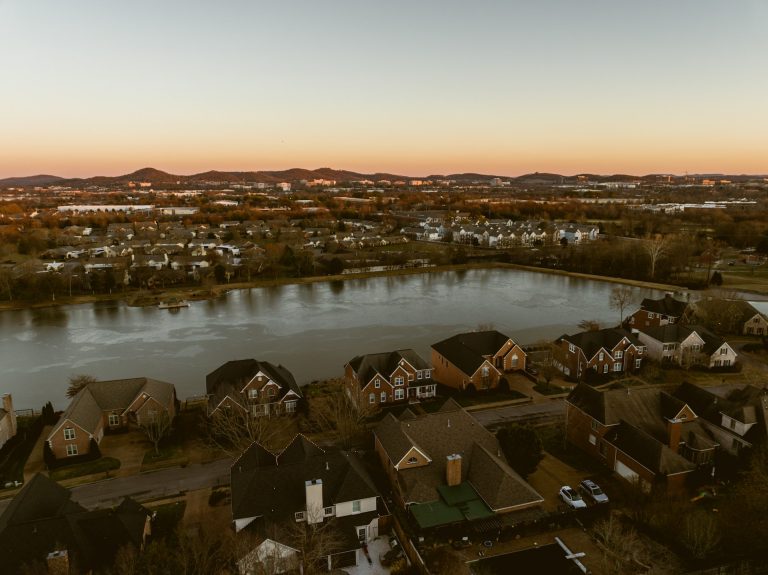
Sumner County’s median home value is $393,100 and its median rent of $1,424 is lower than Rutherford’s or Davidson’s. Hendersonville’s combined 2025 rate is 2.0093 and Gallatin’s is 1.9505. Hendersonville’s shoreline borders Old Hickory Lake, which the Corps of Engineers’ Nashville District oversees. If you are drawn to the water, check each lakeside address on the FEMA flood map and ask about any shoreline use rules before you buy.
How to use these numbers without over-reading them
County figures blend old town centers, new subdivisions and rural land. A county median can sit far from the price of the neighborhood you would choose, so treat the table as a way to sort corridors, then compare neighborhoods within the corridor that fits. If you have not ruled out living inside Davidson County, this guide to comparing Nashville neighborhoods as a buyer covers that side of the choice.
School assignment follows district lines that do not always match city limits, as Lebanon’s two rates show. Ask each district which schools serve a specific address, then use this explainer on weighing school districts during a relocation. Reported crime also depends on the agency that patrols an address, which may be a city police department or the county sheriff’s office, so look up data for each address you are seriously considering.
Put your work address, budget and commute limit on one screen and see which suburban neighborhoods pass all three on SettleSavvy’s free map, which scores areas from 0 to 100 on the priorities you choose.
A weekend to test two corridors
Friday at 5 p.m.: leave your workplace and drive to each suburb on the list. Note the minutes and where traffic stacked up.
Saturday morning: walk the actual blocks you would live on, not the town square. Listen for highway noise and look for sidewalks and parks within walking distance.
Saturday afternoon: run your real errands from each address, groceries, pharmacy and daycare included.
Monday morning: repeat the inbound drive. Weekend traffic flatters every suburb.
Write down one clear advantage and one compromise for each place. This look at what to compare beyond a suburb’s reputation helps frame those notes, and if two suburbs stay close, a side-by-side neighborhood comparison can break the tie. If your employer offers temporary housing, this rundown of relocation benefits worth asking about explains how renting first can buy you time to choose.
Once you have narrowed it to two corridors, a Savvy Consultant can compare your finalists with you on drive times, taxes and household needs, free of charge.
Frequently Asked Questions
Which towns count as Nashville suburbs?
Commonly named suburbs include Brentwood, Franklin, Nolensville and Spring Hill to the south, Murfreesboro and Smyrna to the southeast, Mt. Juliet and Lebanon to the east, and Hendersonville and Gallatin to the north. Officially, the metro covers 14 counties, so towns an hour or more from downtown also fall inside it.
What is the most affordable suburban county near Nashville?
Of the five surrounding counties in our table, Maury comes in lowest on both the Census median home value and the median rent. That comes with one of the longest average commutes, and current prices in fast-growing areas may sit above the survey figures. Compare specific neighborhoods and their full monthly cost, including tax and fuel.
Does living in a Nashville suburb lower my property tax?
Sometimes. Several suburban cities, including Brentwood, Gallatin and Hendersonville, had 2025 combined rates below Davidson County’s 2.782. Others, such as Murfreesboro and Columbia, were close to it. The bill also depends on the home’s appraised value, so compare the full calculation for real addresses.
Is Murfreesboro a suburb of Nashville?
It is part of the official metro area and many residents commute to Nashville, but Murfreesboro is also a major city and job center with its own economy. For people who work there, it functions as home base rather than a suburb, and the daily drive may never involve Davidson County.
Can I commute from the suburbs to Nashville by train?
Only on one line. The WeGo Star runs weekday trains between Lebanon and downtown Nashville, stopping in Mt. Juliet, Hermitage and Donelson. Everywhere else, commuting generally means driving or a bus, so test the drive at the hours you expect to travel.